Showing posts with label Buddhism Databases. Show all posts

Tuesday, April 30, 2013

Galveston County listing resource for faith groups

South Houston Sangha News was initiated in large part because no other comprehensive or up-to-date Buddhism and meditation resource lists were known to be maintained in the greater Houston area at the time of its inception (see this summary for further detail). 

However, local general religious practice and resource lists are published in our area by a number of commercial and on-line sources.  One extensively-developed example is the devotional resource list published by Galveston Daily News every Saturday. 

Instructions for having a religious institution included in this local directory. 

The list for April 20, 2013 included approximately 270 religious centers (there was some repetition across descriptive categories, so this is a rough total quickly counted). 

Screengrabbed from Galveston Daily News, downsampled to illegibility as a Fair Use conformance. 
Not unexpectedly given local demographics, these listings are predominantly Christian.
Again, these percentages are very rough given repetition of listings across categories and other sorting issues. 

The "Other" category encompassed Jewish, Baha'i, Muslim, and Unitarian Universalist groups. 
However, as I verified with Ms. Rhoades by email recently, there are no denominational exclusions intended by Galveston Daily News.  If a faith group such as a Buddhist organization is not represented on this list, that has occurred because the group simply hasn't requested that their information be added.

So with that in mind, I'd encourage Buddhist temples and groups within Galveston County to consider submitting their information to that newspaper.  There's no charge for this public service and the information could prove to be valuable to local seekers. 
In contrast to the local pie chart above, here is Wikipedia's world religions estimate

Monday, November 12, 2012

New data on Buddhism's local prevalence

HuffPost has published this synthesis with a slideshow that details the prevalence of Buddhist adherents across a variety of major American cities, including Houston, Austin, and San Antonio.
According to the way "Buddhist adherents" were measured, greater Houston ranks about mid-way down the list, with 343 Buddhist adherents per 100,000 population. 
Screengrabbed from this source
HuffPost's digest, in turn, is based on this statistical compilation, which was reportedly done nation-wide based on data gathered during the 2010 American national census.
Low resolution screengrab from that source, which advertises their extensive full statistical work as being available for a fee. 
Measurements are presented on a county-by-county basis, with greater Houston being presented thusly:

Same source, again, low resolution presentation with sensitivity toward Fair Use copyright issues

Screengrab of much the same County array as depicted in the low-resolution excerpt above, in which the following Buddhist percentages can be extracted. 
Greater Houston:
Harris County: 0.1-0.49%
Galveston County: 0.1-0.49%
Fort Bend County: 0.5-0.99%
Montgomery County: less than 0.1%
Waller County: 1.0-4.99%
San Jacinto County:  1.0-4.99%

Eastex:
Jefferson County: 0.1-0.49%
Newton County:  1.0-4.99%

County base map supplied by the Governor's office.
These new data can be used to augment this blog's July post titled "How many Buddhists in greater Houston?" in which it was roughly estimated that the number was perhaps around 70,000.  But if we take at face value this new study's measurement of 0.343%  for the area and factor that into the general population estimate of 6 million, we instead end up with 20,580, which is significantly lower. 

The differences may be arising in part because of the way that "adherent" is defined and measured in this study with its emphasis on "congregational participation", which is perhaps a more relevant metric for mainstream American faith groups (e.g., Christian lineages) than it is for Buddhism.  There are a great many individuals who may deem themselves to be either Buddhist or Unlabeled without declaring a specific institutional affiliation.  Other measurement sources have clearly indicated that Houston's Vietnamese contribution alone should well surpass this relatively low estimate of overall Buddhism prevalence. 

At any rate, it's good to have more reference data points, and this study also raises some new questions.  In particular, why are higher participation rates measured outside of the greater Houston urbanized core?  Specifically, in Waller, San Jacinto, and (of all places) Newton County, which is located in culturally-distinct deep East Texas.  These are intriguing questions, perhaps for future blog posts.

Tuesday, August 28, 2012

Buddhism and meditation outreach

The purpose of this post is to leave a "scent marker" that will be of use to anyone considering the creation of a Buddhism and/or meditation outreach site in their own geographic area.  South Houston Sangha News is only a few months old now, but I've learned a few important and surprising lessons about running this kind of blogsite, and those lessons are worth sharing at this point.
Blogs are inherently non-local phenomena.  Even though South Houston Sangha News targets the upper Texas coast and, with its newness, has not yet established a robust traffic pattern, it receives visitors from all over the world.  This is a partial list of countries with visitors arriving within the past several weeks.
Surprising Lesson #1Almost nobody else is creating this kind of outreach resource at the present time.  I've already talked about the lack of a comparable resource in the greater Houston area, which probably has one of the largest established Buddhist populations in the United States.  But the same has proven to be true all over.  In order to research this issue, I've relied on open internet searches and also on the meta-site called Blogisattva, which developed a highly-respected award system for excellence in Buddhist blogging a few years ago.  Unfortunately, I can't supply a reference URL for Blogisattva because, for unknown reasons, the entire site was pulled down just a few weeks after I retrieved their site database (if anyone wants a copy of that, please email me).  To date, I've reviewed 315 of the 458 Buddhist blogs and websites listed in their database, and I've identified only two (!!) that supply any discernable geographic outreach benefit, as follows:
  • Michigan Buddhist.  This is a true "one-stop" outreach meta-site, and is fabulously constructed both in terms of esthetic design and technical sophistication.  As the "About" section conveys succinctly, "Michigan Buddhist collects and distributes Dharma-related information of particular interest to Michigan practitioners. We publicize speakers, retreats and happenings, and maintain a listing of temples, sangha, meditation centers, and discussion groups throughout Michigan. We provide a list of relevant links for those looking to learn about Buddhism and inform their practice, and a calendar of upcoming events."
  • The Sumeru Guide to Canadian Buddhism.  This site does not investigate the groups and Temples that it tabulates, nor does it appear to track and publicize events or collate news content, but it is a very thorough, well-designed, and frequently-updated directory of basic resources.
Why are there so few true Buddhist outreach sites?  I don't want to get too deeply into speculation, but I suspect that it's because this kind of "grunt work" is less attractive to people as a blogging focus.  It's exciting and sexy to publish personal reflections that others actually read, and it's exciting and sexy "be a benefit" to Tibetans, to homeless people, to displaced peoples, and to incarcerated people.  Believe me, it's not very exciting and sexy to slog through hundreds and hundreds of narrowly-focused "personal reflection" blogs searching for those rare gems that might actually be a benefit to ordinary middle-class non-newsmaking American people who are facing monumental challenges in their lives.  Which brings me to my second point -

Non-Surprising Lesson #2:  Geographically-based Buddhism and meditation outreach is sorely needed.  There seems to be a tacit assumption that those ordinary middle-class non-newsmaking American people are not high priorities for outreach.  After all, do most of them not have comfortable lifestyles, especially compared to most of the world's peoples?  Don't most of them have gainful employment?  Access to education?  Why should they be a focus?  By the very fact that they are lucky enough to be in America, are they not already equipped to identify and procure spiritual resources under their own power?

Such a perspective is not a very compassionate view.  American residency is no guarantee that life will be even remotely free of suffering.  Even in my very limited spiritual travels, I've met people who have debilitating health problems that inflict chronic pain upon them, who have experienced the tragic deaths of their closest loved ones, who have been the victims of violent crime, whose families have abandoned them, who are ensnared in addiction, and who have been systematically violated by institutional Christianity.  Very often when people are actively searching for new spiritual resources such as meditation groups, it is in response to some acute crisis unfolding in their lives.  I've heard stories of pure despair from people trying to cope with a complete lack of informational resources and outreach as they conduct their searches, an unfortunate reality that imparts unnecessary insult to their existing life injuries.  Rest assured, if you decide to initiate a true meditation and Buddhism outreach site in your geographic area, you will be supplying an immediate benefit to people who warrant compassion.

Surprising Lesson #3:  Many "Buddhism outreach" search engine hits actually refer to missionary sites that seek to convert Buddhists to Christianity, rather than to sites that supply meditation and associated resource information.  Examples here ("ministering to people influenced by Buddhist worldviews") and here ("Christ's Great Commission gives Christians a mandate to take the gospel to every person, including the large number of Buddhist peoples. Since we understand that Buddhists are seeking truth, and because Jesus Christ is "the Truth," we are doubly bound to declare the gospel to them").  These sites are not helpful to people who are searching for true Buddhism and meditation outreach, and thus it is useful to counterbalance those viewpoints by supplying actual resources.  It's important to recognize that I'm not talking about prosetylizing here.  I'm just talking about making specific information readily available to those people who are actively searching for it. 

I've added a link category called "OTHER REGIONAL OUTREACH SITES" in the left-hand column of this blog layout where I will list any additional useful resources that I encounter in my web travels.  If you are considering the creation of a Buddhism and/or meditation outreach site in your local area, please refer to that section for additional good examples and ideas, and feel free to contact me via southhoustonsangha - gmail if you need advice or assistance.  Thanks!! 

Sunday, July 22, 2012

How many Buddhists in greater Houston?

The Buddhist blogosphere (e.g., here, and here) is all a-buzz with the results of this recent Pew Forum study, which revises upward (in fact, almost doubles) previous estimates of Buddhism prevalence in the United States.  According to that study, between three and four million people nationwide declare themselves to be Buddhist.

It raises the obvious question:  Given this new information, how many Buddhists are there in greater Houston?
Small statue on the grounds of Chua Phap Nguyen / Dharma Spring Temple, Pearland, TX.
An estimate can be derived in a couple of different ways.  First, a straight percentage calculation can be done using the population for "greater Houston" (which is defined by the U.S. Census as an "urbanized area").
Yikes, that's hard to read. 
Go to this link if you'd like legible information.
The July 2011 total population estimate for greater Houston is 6.08 million persons.  Taking the Pew population prevalence at face value (between 1% and 1.3%) yields somewhere between about 60,000 and 80,000 local Buddhists.
Growing, growing, and growing, Buddhist or otherwise. 
Total area population graph from this economic development source
It would be interesting to further refine (or at least corroborate) that number with an estimate based on the local population composition itself, rather than by simply applying national statistics.  Here, it's easy to get confounded by statistics that pertain to "Houston" (the City of) and "greater Houston" (the metropolitan area).  According to the 2010 Census racial statistics for the City of Houston, 6.4% of the population is Asian.  Extrapolating this regionally and coupling it with the Pew estimate that 14% of Asian Americans are Buddhists yields a local population of about 54,000 just from the membership contributions of Asians alone.  Pew Forum also noted that roughtly one third of American Buddhists are not Asian.  Assuming this same ratio holds true locally, the total number would then be estimated at roughly 82,000 local Buddhists, which is in line with the general estimates given above.  However, this estimate may be a little inflated, because greater Houston's Asian population is a bit larger than the 5% national average

The Pew study also reveals that Vietnamese identification with Buddhism is particularly strong, and is, in fact, the only measured Asian nationality for which Buddhism dominates.
Screengrabbed from here.
Well-known Houston blogger Tory Gattis has described the recent substantial migration of Vietnamese Americans to the greater Houston area, building on descriptions published by the Los Angeles Times and other sources.  Tory estimated that there were 85,000 Vietnamese Americans in Houston as of 2006, but also referenced a HAIF thread which estimated 160,000 - 180,000 within the greater Houston area.  Census numbers can be difficult to tease apart, but this blog article estimated 104,000 Vietamese Americans in the Houston area as of 2010.  Taking that number, which is the middling estimate, and coupling it with the Pew percentage, would yield approximately 45,000 local Vietnamese American Buddhists alone.

To the approximately 70,000 local Buddhists out there, I say hello and welcome.
:-)

Wednesday, May 9, 2012

Houston Buddhism databases

In this post, I'm going to describe two local and one national Buddhism information resources.  As of today, all of these sources are incomplete, such that if a seeker uses them to gauge either the breadth or depth of Houston's Buddhist community, an inaccurate picture will result.  However, all have the potential for independent updates and may further develop to become valuable comprehensive information resources, so they are noted here for possible future reference as well as perspective.

In researching these sources, I contacted members of Houston's academic community for input, and I thank them for their attention and replies.

(1) The Harvard Pluralism ProjectDr. Michele Verma, Lecturer in the University of Houston Religious Studies Program, was unaware of any viable compilations describing local Buddhism, but suggested I investigate the Harvard Pluralism Project.
The website allows searching by tradition, and searching geographically.
Map resources were also provided, but it's immediately apparent that portions of the database have not been updated in eight years.
As well as the general searchable database resources given above, the Harvard group has examined religious diversity in more detail within a subset of major American cities.  Unfortunately for us, as of this writing, greater Houston is not yet among those profiled online.
An effort has been made to profile different Buddhist organizations in Austin, Texas.  Each listed center has been evaluated in a manner analogous to those being added to the "Temple Profiles" section of South Houston Sangha News.
(2) The local "Buddhism in Houston" list.  Dr. Anne C. Klein, published author on Buddhism, one of the founders of Houston's Dawn Mountain Temple, and Professor in the Rice University Religious Studies Department (Wiki profile here), had previously been maintaining a linked list of local Buddhist groups.  Responsibility for the list was later assumed by another individual who noted on the webpage that maintenance of the list was "OBE" - overcome by events - such that updates could not be continued.
This is what the page banner looked like as of this blog post.  This resource list has not been updated since 2002.
These were the listed facilities as of 2002.  In an email, Dr. Klein noted that the list had never been complete with respect to ethnic Buddhist Temples, especially Vietnamese.
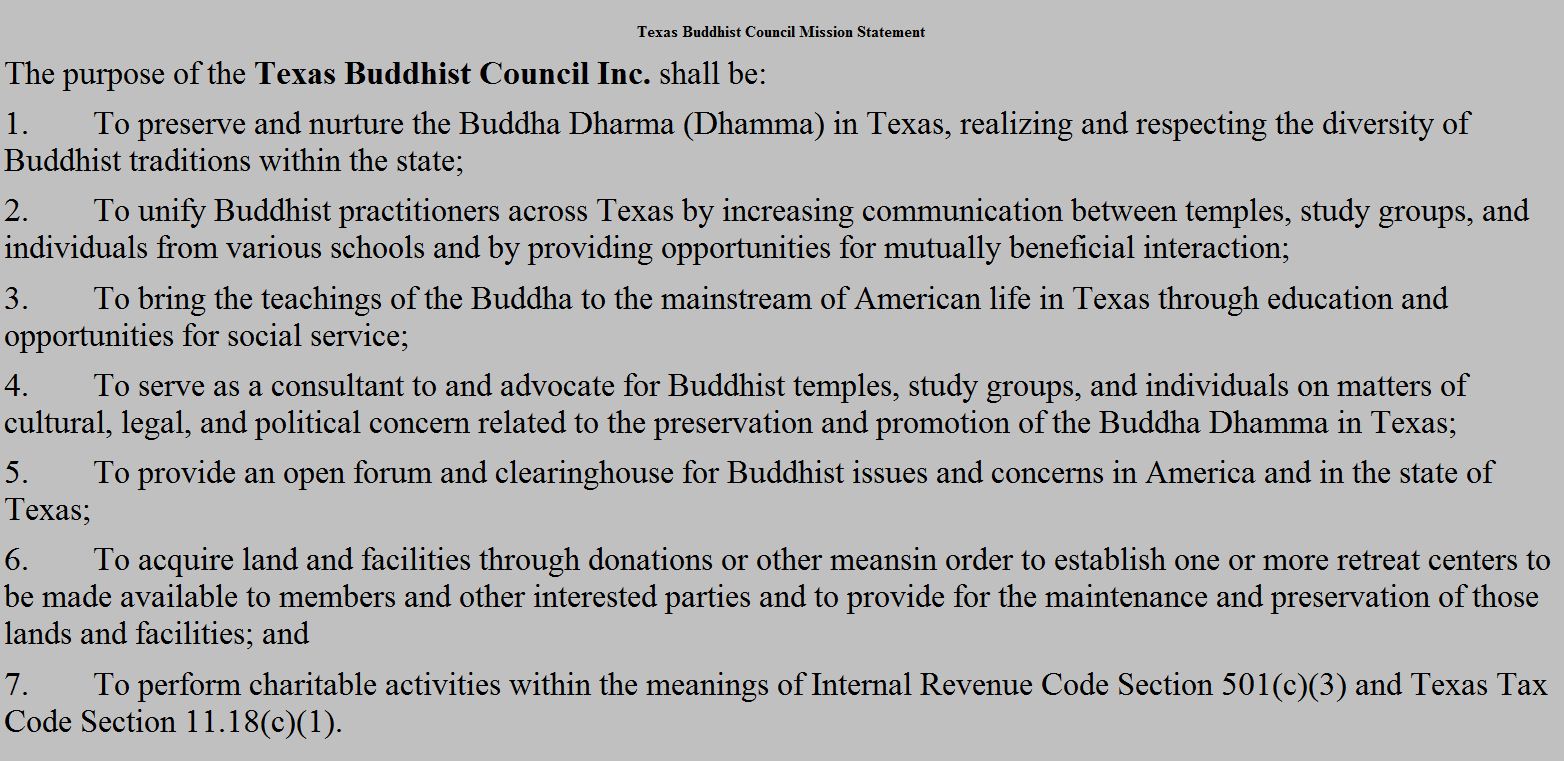
(3) Texas Buddhist Council (TBC).  A perusal of the list above reveals the existence of an entity called the Texas Buddhist Council.  In fact, the type of databasing, profiling, and communication being attempted by South Houston Sangha News is more typically undertaken by centralized nonprofits such as this entity appears to be.  Running down its identity revealed this de facto homepage, which appears not to have been updated since 1998. 
Texas Buddhist Council mission statement from the webpage cited above. 
The TBC appears to have been initiated as a true inter-congregational, inter-Temple effort (some "Councils" and "Associations" are really vehicles designed to promote a particular group or lineage rather than Buddhism as a whole).  However, TBC does not appear to be active at this time.  The webpage is associated with Houston Buddhist Vihara which, as described in this previous "Temple profile", currently does not have any English-speaking Venerables in residence.  Furthermore, the TBC website references information contributions coordinated by a John RB Whittlesey.  Unrelated internet resources suggest that Mr. Whittlesey may have since passed away (not confirmed!). 

So there you have the best current information that I've been able to find on local inter-group Buddhist associations and database resources.  As always, if you have additional information, please email me via southhoustonsangha -at- gmail.